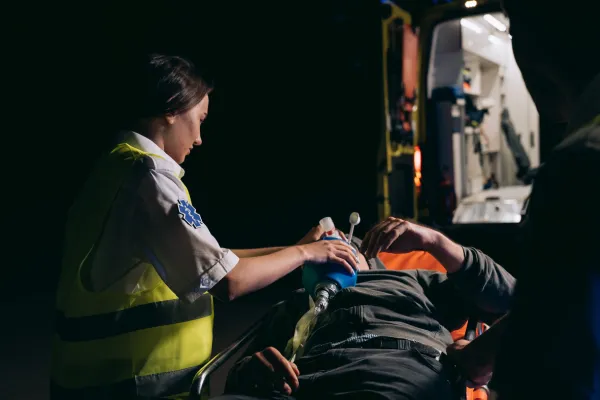
The Hidden Cost of Being a Hero: Mental Health Challenges for First Responders
The Title “Hero” Comes With a Cost

Society often calls police officers, firefighters, paramedics, and dispatchers “heroes.”
It’s a word meant to show respect. Gratitude. Recognition.
But behind that word is something people don’t always see:
Expectation.
When you are labeled a hero, you are expected to:
Stay strong no matter what
Handle anything thrown at you
Keep going, no matter how heavy it gets
And over time, that expectation can become a burden.
Because no matter how capable, trained, or resilient you are—
You are still human first.
Looking Beyond the Uniform
The uniform represents authority, control, and reliability.
But it can also become a mask.
One that hides:
Exhaustion
Emotional strain
Unprocessed trauma
First responders step into situations most people spend their lives trying to avoid.
You witness:
Loss
Violence
Crisis
Human suffering at its most intense
And then you’re expected to move on to the next call as if nothing happened.
No pause.
No reset.
No time to fully process.
The Weight of Cumulative Trauma

There’s a common misconception about trauma in emergency services.
People often think it comes from one major, catastrophic event.
But more often, it doesn’t.
It comes from accumulation.
The “Stacking Effect” of Stress
It’s:
The difficult call that lingers
The family you couldn’t help
The accident scene that replays in your mind
The constant adrenaline spikes followed by emotional crashes
One by one, these experiences stack.
And eventually, they become heavy.
Very heavy.
How It Affects the Brain and Body
Cumulative trauma doesn’t just stay in your thoughts.
It impacts your entire system:
Your nervous system stays on high alert
Your sleep becomes disrupted
Your body struggles to relax
Your mind replays moments you’d rather forget
Even when you’re home.
Even when you’re safe.
Your brain doesn’t always recognize that the danger has passed.
When “Strong” Becomes Silent
Strength is essential in emergency work.
But there’s a difference between strength and suppression.
In many departments, there’s still an unspoken rule:
Handle it. Don’t talk about it. Move on.
That culture creates pressure to:
Hide emotions
Avoid vulnerability
Push through pain without processing it
And while that may help during a shift—
It creates problems after.
The Pressure to Stay Unbreakable
First responders are often seen as the ones who hold everything together.
So when things start to feel overwhelming internally, it can feel like:
You’re not allowed to break.
You might think:
“I should be able to handle this.”
“Others have it worse.”
“I can’t let my team see me struggle.”
So instead of reaching out—
You stay quiet.
The Hidden Cost: Isolation
This is where the real cost shows up.
Not just in stress or fatigue—
But in isolation.
You may:
Laugh with your crew
Show up for your family
Keep everything looking “normal”
While internally:
You feel disconnected
You’re running on empty
You’re carrying more than anyone realizes
Maintaining that strong front takes energy.
A lot of it.
And eventually, that energy runs out.
When the Mind Pays the Price
Ignoring mental health challenges doesn’t make them disappear.
It often intensifies them.
Over time, untreated stress and trauma can lead to:
Burnout
Sleep disorders
Irritability or anger
Emotional numbness
Depression
These aren’t signs of weakness.
They are signals.
Your mind and body are asking for support.
Why Mental Health Support Is Not Optional
In high-stress professions, mental health care is not a luxury.
It’s a necessity.
Just like:
Training
Equipment
Physical fitness
Mental health support is part of staying effective on the job.
It helps you:
Process what you experience
Regulate stress responses
Maintain clarity under pressure
Stay present in your personal life
What Real Support Looks Like
Support doesn’t look the same for everyone.
And it shouldn’t.
Different people need different approaches.
That might include:
Professional therapy
Peer support programs
Holistic therapies that address both mind and body
Structured recovery routines
Stress regulation techniques
The goal isn’t to force one solution.
It’s to find what works for you.
Breaking the Cycle
The cycle of silence and suppression can be broken.
But it starts with one shift in perspective:
You don’t have to carry everything alone.
Talking about mental health doesn’t make you less capable.
It makes you more sustainable.
A Message to First Responders

If you’ve been carrying more than you let on—
That doesn’t mean you’ve failed.
It means you’ve been doing a difficult job under extreme conditions.
Support exists for a reason.
And using it doesn’t take away from your strength—
It protects it.
A Message to Families and Support Systems
If you support a first responder, you play an important role.
You may not see everything they carry.
But your presence matters.
You can help by:
Creating space for conversation
Listening without judgment
Encouraging support when needed
Being patient with the process
Sometimes, knowing someone is there is the first step toward change.
The Phoenix Foundation: Lifting the Hidden Weight
At The Phoenix Foundation, we recognize the true cost of being a hero.
That’s why we provide:
Free
Confidential
Holistic mental health services
For first responders whose workplace benefits have been exhausted.
We believe:
No one should have to choose between healing and affordability
No one should have to carry trauma alone
Every first responder deserves access to real support
Help Us Support Those Who Serve
First responders show up for us every day.
It’s time we show up for them.
If this message resonates:
Share this blog with someone who needs it
Start a conversation
Help raise awareness
And if you’re able—
Consider making a donation.
Your support helps provide life-changing mental health care to those on the front lines.
Because Even Heroes Need Support
Being called a hero is an honor.
But it should never come at the cost of your well-being.
Behind every uniform is a person.
And that person deserves:
Rest
Support
Healing
The hidden cost doesn’t have to stay hidden.
With the right support—
It can be lifted.
