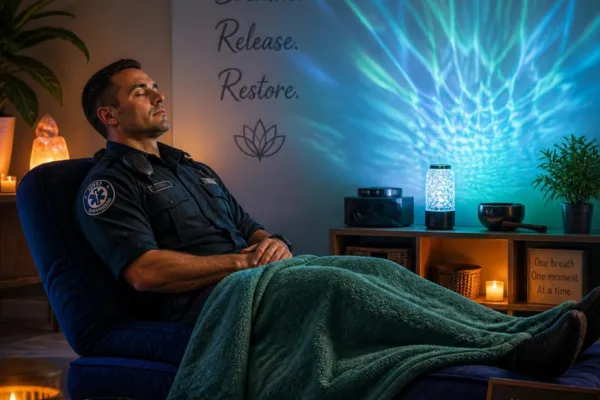
The Science of Healing: How Light, Sound, and Energy Therapies Transform Mental Health
Every day, first responders are exposed to situations that push the mind and body to their limits.
Police officers, firefighters, paramedics, dispatchers, military personnel, and correctional officers regularly encounter emergencies, trauma, and loss. They make life-changing decisions under immense pressure, often carrying the emotional impact of those experiences long after their shifts have ended.
Over time, chronic stress can begin to change the way the brain and body function. Sleep becomes difficult. Anxiety lingers. Muscles remain tense. Even moments of peace can feel unfamiliar.
Traditional mental health support remains essential, but many first responders discover that talking alone does not fully address the physical and emotional effects of trauma. Increasingly, researchers and mental health professionals are exploring innovative approaches that work directly with the nervous system.
At The Phoenix Foundation, we recognize that healing can take many forms. Light therapy, sound therapy, and energy healing offer new possibilities for individuals seeking relief from stress, anxiety, and the lasting effects of trauma.
These therapies may seem unconventional at first glance, but growing scientific understanding continues to reveal how profoundly the mind and body are connected.
Understanding the Science of Trauma
Trauma affects much more than thoughts and memories.
When the brain perceives danger, it activates the body's survival systems. Hormones like adrenaline and cortisol flood the bloodstream, preparing a person to react quickly in high-pressure situations.
For first responders, this response is not an occasional event—it is part of daily life.
Repeated exposure to emergencies can leave the nervous system stuck in a constant state of alertness, resulting in symptoms such as:
Chronic stress and burnout
Anxiety and hypervigilance
Difficulty sleeping
Emotional exhaustion
Trouble concentrating
Muscle tension and headaches
Depression and hopelessness
Increased irritability
Even after a shift ends, the body may struggle to recognize that the danger has passed.
Holistic therapies focus on helping the nervous system regulate itself, creating opportunities for healing that extend beyond traditional talk therapy.
Light Therapy: Using Science to Improve Mood and Sleep
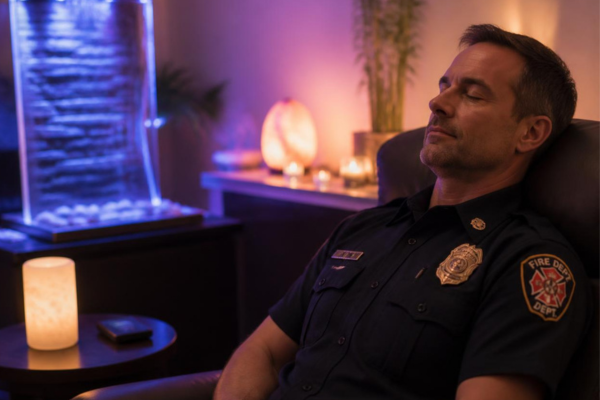
Light influences nearly every aspect of human health.
Our bodies rely on natural light to regulate circadian rhythms, the internal clock that controls sleep, energy levels, and mood. Shift work, overnight calls, and irregular schedules often disrupt this rhythm for first responders, contributing to fatigue, insomnia, and emotional distress.
Light therapy uses specific wavelengths of light to support the body's natural processes.
Research has shown that carefully designed light treatments may help:
Improve sleep quality
Regulate mood
Reduce symptoms of anxiety
Combat fatigue
Support emotional well-being
Enhance focus and mental clarity
For individuals who spend years working rotating shifts or overnight schedules, restoring healthy sleep patterns can dramatically improve both physical and mental health.
Beyond sleep, light-based therapies are increasingly being explored for their potential role in supporting people recovering from trauma and chronic stress.
Sound Therapy: Calming the Brain Through Frequency
Sound has always influenced human emotions.
Music can energize us, comfort us, or bring back memories. Today, modern sound therapy builds on this understanding by using specific frequencies and rhythmic patterns to promote relaxation and emotional balance.
Some forms of sound therapy incorporate:
Binaural beats
Guided meditation
Therapeutic music
Vibrational frequencies
Breath-focused sound exercises
These techniques work by encouraging the brain to transition from heightened states of alertness into calmer, restorative states.
For first responders, whose nervous systems often remain locked in "fight-or-flight" mode, sound therapy may help:
Quiet racing thoughts
Reduce anxiety
Improve concentration
Encourage relaxation
Support emotional regulation
Promote deeper sleep
Many individuals describe feeling calmer and more centered after sessions, even when they struggle to relax through conventional methods.
The science behind sound therapy continues to evolve, but its goal remains simple: helping the brain find moments of stillness in a profession defined by constant noise.
Energy Healing and Reiki: Restoring Balance

Among holistic therapies, Reiki and energy healing are often the least understood.
At their core, these practices focus on relaxation, stress reduction, and emotional restoration. During a Reiki session, practitioners use gentle touch or place their hands just above the body to create an environment that encourages calm and balance.
Many first responders who try Reiki report experiences such as:
Deep relaxation
Reduced physical tension
Improved sleep
Emotional release
Lower stress levels
Greater feelings of peace
Although energy healing approaches continue to be studied, many experts believe that their benefits may stem from activating the body's relaxation response and reducing nervous system activation.
For individuals who spend years functioning in survival mode, even a brief opportunity to slow down can have meaningful effects.
Healing does not always require reliving painful memories. Sometimes, recovery begins by giving the body permission to rest.
Why These Therapies Matter for First Responders
First responder culture values strength, composure, and resilience. Those qualities are essential in emergencies, but they can also create barriers when it comes to seeking help.
Many professionals hesitate to pursue therapy because:
They fear being judged.
They do not want to revisit traumatic experiences.
Traditional talk therapy feels overwhelming.
They believe they should handle everything on their own.
Light, sound, and energy therapies offer another option.
These approaches do not replace traditional mental health treatment. Instead, they complement it by working directly with the body's stress response systems.
For many first responders, holistic therapies provide:
A non-invasive path to healing
Relief without extensive verbal processing
Tools for nervous system regulation
Additional support alongside counseling
Opportunities to reconnect with themselves
Healing is deeply personal, and there is no single approach that works for everyone. The goal is not to find the "perfect" therapy—it is to discover what helps you feel safe, grounded, and hopeful.
The Connection Between Science and Hope
The conversation around mental health is evolving.
Researchers now understand that trauma affects the brain, body, and nervous system in complex ways. As science continues to explore innovative therapies, first responders have more options than ever before.
This growing understanding carries an important message:
You are not weak because you struggle.
Your reactions are not failures.
The exhaustion, hypervigilance, and emotional weight you carry are normal responses to extraordinary experiences.
And just as trauma changes the brain, healing can change it too.
Neuroplasticity—the brain's ability to adapt and form new pathways—means that recovery remains possible, even after years of chronic stress.
Every small step toward healing matters.
A Message to Families and Loved Ones

Mental health challenges rarely affect only one person.
Spouses, children, parents, friends, and coworkers often witness the impact of stress and trauma long before a first responder asks for help.
If someone you care about is struggling, remember:
Listen without judgment.
Encourage open conversations.
Be patient with the healing process.
Explore different support options together.
Remind them that seeking help is a sign of strength.
Sometimes, knowing that support exists is enough to inspire someone to take the first step.
Healing Is Possible
Imagine waking up after a full night's sleep.
Imagine feeling calm instead of constantly on edge.
Imagine carrying memories without being controlled by them.
This is what healing can look like.
At The Phoenix Foundation, we believe that every first responder deserves access to compassionate, holistic mental health support. Whether through traditional counseling, light therapy, sound therapy, Reiki, or other innovative approaches, there is always hope for a brighter future.
You have spent your career protecting others.
You deserve the opportunity to heal, rest, and reclaim your own well-being.
Because healing is not only possible—it is within reach.
